
TopCarPlay: the quietest upgrade your daily commute has ever had
Why a wired CarPlay setup eventually feels broken
Most modern vehicles ship with wired Apple CarPlay or Android Auto, and at first the experience feels great. Fast forward twelve months: the cable is frayed near the connector, the port wobbles a little, your phone falls mid-drive, and you are fumbling for a lightning lead with one eye on the road. TopCarPlay was built for that exact frustration, the one that sneaks up on you as the novelty of the dashboard screen wears off.
Swapping a whole head unit is expensive and usually means losing your factory warranty. Most third-party dongles tackle the symptom (no cable) but trade it for a new annoyance slow pairing, laggy audio, interruptions when text messages come in, or missing support for half your household's devices. TopCarPlay aims at the middle path: keep your factory screen, keep your steering wheel controls, drop the cable, and do it with the kind of stability you would expect from a direct wired connection.
What actually happens when you plug it in
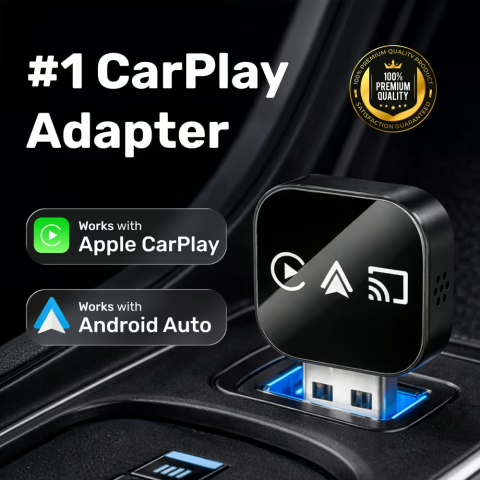
The first time you install TopCarPlay, you slot it into your dashboard's USB-A port (or use the bundled USB-C tip if your car is newer). Your car sees what it thinks is a phone, and CarPlay or Android Auto boots up on the screen like always. Your phone, meanwhile, picks up the adapter over Bluetooth 5.0 and offers to pair. You tap once, and a 5GHz Wi-Fi channel opens between the two. From that point on, every subsequent drive reconnects on its own in under ten seconds usually before you have finished putting your seatbelt on.
The reason it feels seamless is the split architecture. Bluetooth is fast at discovery but slow at streaming, while Wi-Fi is slow at discovery but great at streaming. TopCarPlay uses each one for what it is best at: Bluetooth confirms the device and kicks off the handoff, and the 5GHz Wi-Fi link carries the actual audio and video payload without the congestion you get on the 2.4GHz band that microwaves, doorbells and competing dongles live on.
Why the 5GHz detail matters more than it sounds
On paper, 5GHz versus 2.4GHz sounds like pedantic spec-sheet talk, but the difference is where most cheap adapters fall over. 2.4GHz is shared with a long list of everyday radios: Bluetooth itself, Wi-Fi routers, wireless headphones, car key fobs in some cases, and the very phone you are trying to pair. The result: stutter when you get voice navigation while music is playing, crackle on phone calls, or random one-second dropouts when a text comes in.
By pushing TopCarPlay onto the 5GHz band, that noise floor goes away. Audio arrives in near real time, Apple Music lossless streams without compression, and turn-by-turn voice prompts over Google Maps or Waze come in crisp and synced. It is the difference between a demo that works in the shop and an adapter that actually holds up on a 300-mile drive.
A genuinely 2-in-1 adapter for households that mix platforms
One of the most common complaints with wireless dongles is the phone lottery you buy one for CarPlay, and then your partner with a Pixel cannot use it. TopCarPlay supports Apple CarPlay and Android Auto in the same unit, so one adapter covers an iPhone, a Samsung, a Pixel, or whatever your household picks up next. You can even pair multiple phones: whichever device gets in the car first is the one that connects, which is particularly handy for couples sharing a daily driver.
Because the adapter takes over exactly where your factory wired protocol leaves off, every native car control stays untouched. Siri and Google Assistant wake from the steering wheel, voice dial still goes through the cabin microphone, and the factory music, skip and volume buttons behave normally. Nothing about the dashboard experience changes the cable just disappears.
Designed for everyday drivers, not engineers
We specifically wanted to avoid the kind of adapter that requires a companion app, a firmware flashing utility on a Windows laptop, or a sideways trip into the dealer service menu. TopCarPlay ships with zero software requirements. There is no TopCarPlay app, no firmware button combinations, no account to create. You open the box, you plug in the dongle, you pair once on the first drive, and you are done forever.
Physically, the unit is compact enough to hide behind the lip of the console or inside the glove box with the cable tucked neatly away. Most drivers forget it is there which is the point. The goal is to make wireless CarPlay feel like the car came from the factory that way, not like you bolted on a gadget.
Who TopCarPlay is really for
This adapter is for drivers who are tired of three specific things: worn-out phone cables, dash port wobble, and laggy dongles that made them swear off the wireless CarPlay category years ago. It is for commuters who connect daily, rideshare drivers who want an adapter that re-pairs fast between trips, families who share one car across iPhone and Android devices, and road-trippers who want a ten-hour drive without a single dropout.
It also makes a strong gift. The kind of accessory nobody buys for themselves, but everybody quietly uses every day once it is in the car.
A small dongle with a big daily payoff
TopCarPlay fixes something that annoyed you every single day, but that you had stopped consciously noticing. You get in the car, the screen wakes up, your maps and music are already there, your hands are on the wheel, and you are out the driveway. Combined with a 90-day money-back guarantee, the downside of trying it is effectively zero and the upside is that you never reach for a cable again.